
THE EVOLUTION OF TIME ZONES: KEEPING THE WORLD IN SYNC 🌍🕒

Uncover the intriguing journey of time zones from local solar times to today’s global synchronization, driven by transportation and technology.
INTRODUCTION
Imagine a world where every town had its own unique time based on the sun’s position. Sounds chaotic, right? Yet, not too long ago, this was the reality across the globe. Time zones, as we know them today, were born out of necessity—primarily driven by the rise of transportation and communication. Let’s embark on a journey through the fascinating history of time zones in the United States and around the world.
THE BIRTH OF TIME ZONES: A NECESSITY EMERGES 📅
Before the establishment of time zones, societies relied on solar time, which varied with geographical location. However, the rapid expansion of railroads in the 19th century necessitated synchronization. In 1869, the completion of the Transcontinental Railroad highlighted the chaos caused by differing local times. Travelers faced the challenge of coordinating schedules across vast distances.
In response, Sir Sandford Fleming proposed a system of standard time zones in 1879, resulting in the establishment of four primary time zones in North America. The U.S. officially adopted these time zones on November 18, 1883, a day that became known as “The Day of Two Noons.”
Questions to Consider:
- What were the societal impacts of varying local times before standardized time zones?
- How did the establishment of railroads specifically influence timekeeping?
THE ROLE OF TRANSPORTATION IN TIME STANDARDIZATION 🚆
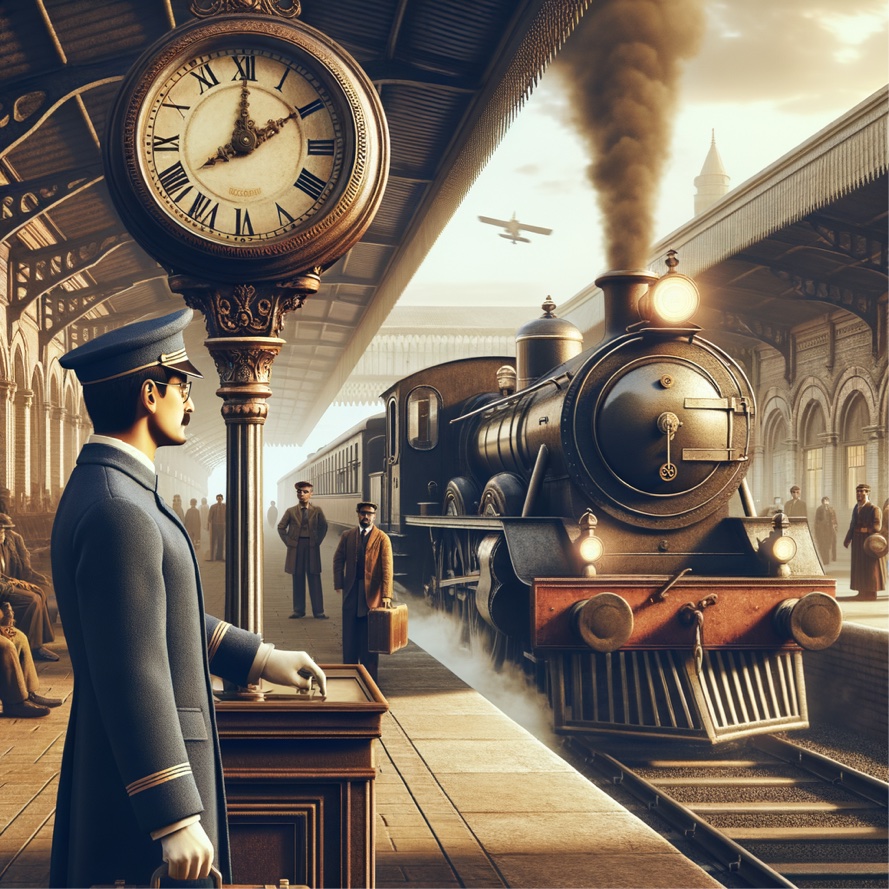
With the dawn of the industrial age, transportation became a critical factor in the development of time zones. As trains began to crisscross the country, the need for dependable schedules became paramount. Inconsistent local times resulted in missed connections and chaos at train stations.
In 1884, the International Meridian Conference convened in Washington, D.C., where delegates from 25 countries agreed to establish the Greenwich Meridian as the prime meridian, from which all time zones would be calculated. This marked the global acknowledgment of standardized time, further influenced by advancements in aviation and telecommunications.
Questions to Consider:
- How did aviation advancements in the 20th century further shape our understanding of time?
- In what ways has technology changed the way we perceive and manage time today?

THE IMPACT OF GLOBALIZATION AND TECHNOLOGY 🌏💻
As the world became more interconnected, the need for accurate timekeeping grew. The 20th century saw the proliferation of international travel and communication, driving further refinement of time zones. Atomic clocks, which emerged in the 1950s, revolutionized timekeeping by providing unparalleled accuracy, leading to the establishment of Coordinated Universal Time (UTC).
However, the introduction of Daylight Saving Time (DST) during World War I and II as a temporary measure for energy conservation became a permanent fixture in several countries. This practice, along with the existence of time zone boundaries, still sparks debate today.
Questions to Consider:
- What are the pros and cons of Daylight Saving Time?
- How do cultures around the world adapt to time zone differences in their daily lives?
THE EVER-CHANGING NATURE OF TIME 🌟
The history of time zones reflects humanity’s evolving understanding of time itself. From local solar times to a global system of synchronization, our need for order and efficiency has shaped how we organize our lives. As transportation and technology continue to advance, who knows what the future holds for our relationship with time?
With this engaging exploration of the history of time zones, we hope to inspire curiosity and understanding of how time continues to shape our lives across the globe!
ADDITIONAL RESOURCES
- National Institute of Standards and Technology (NIST) Time Zone Information
- History of Time Zones by the U.S. Naval Observatory